

Radio Brisvaani
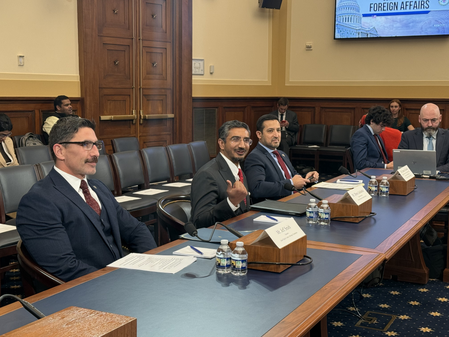
Washington, Dec 11 (IANS) India has demonstrated the “stiffest resistance” to China’s growing aggression across the Indo-Pacific, top American experts on South Asia told lawmakers.
During a closely watched hearing of the House Foreign Affairs Subcommittee on South and Central Asia on the US–India strategic partnership on Wednesday (local time), these experts underscored deepening bipartisan concern in Washington over Beijing’s attempts to dominate the region militarily, economically, and digitally.
Jeff Smith of the Heritage Foundation told the subcommittee that India “has engaged in… stopping Chinese coercion at their border,” calling New Delhi’s countermeasures among the most decisive taken by any of China’s neighbours. “Unlike us, it was able to ban TikTok essentially overnight,” he said. He added that India “banned dozens of Chinese apps” and imposed “fierce restrictions on Chinese investments… that could pose security risks.”
Committee Chairman Bill Huizenga warned that China’s “string of pearls ideology is… an overt attempt to encircle and control the Indian Ocean.” He said this expansion “is no longer just a theory,” and argued that India’s strategic location and growing naval strength make it indispensable to maintaining a free and open Indo-Pacific.
Dhruva Jaishankar from ORF America reminded lawmakers of the 2020 border clashes, noting that China’s mobilisation “resulted in clashes in which 20 Indian military personnel lost their lives.” He said Beijing’s expanding military footprint — from nuclear modernisation to new unmanned and cyber systems — combined with its network of overseas ports, could “be used to secure critical choke points.”
Smith said Washington must reinforce New Delhi’s capabilities, deepen intelligence-sharing, and support India’s maritime posture from the Andaman and Nicobar Islands to the Western Pacific. “India has shown the stiffest resistance,” he told lawmakers. “Where India is positioned between China and the US matters a great deal.”
Witnesses also warned that Beijing’s behaviour is pushing India and the US closer together despite recent trade frictions. “This remains a low-cost, high-benefit partnership for the United States,” Smith said.
The testimony reflected a rare consensus: China’s military pressure will continue, and the US–India partnership is emerging as one of Washington’s most consequential tools to counter it.
Huizenga said in recent years, China has expanded and modernised its nuclear arsenal, undertaken one of the largest naval buildups in its history, and unveiled new unmanned and cyber systems.
In 2020, a major mobilisation by the PLA resulted in clashes in which 20 Indian military personnel lost their lives. China has also developed a network of potentially dual-use ports across the Indo-Pacific and beyond that might be used to secure critical choke points.
The Indian Navy, as a result, has stepped up, increased the tempo of its patrols, and contributed to maritime burden sharing in the Indian Ocean and Pacific, he said.
Sameer Lalwani from the German Marshall Fund said partnering with India helps the United States sustain its own long-term technological leadership and win the strategic competition with China. Defence cooperation, which plays a critical role in balancing China’s military power, includes joint US-India military exercises, intelligence cooperation, logistics agreements, and defence co-development.
–IANS
lkj/sd/