

Radio Brisvaani
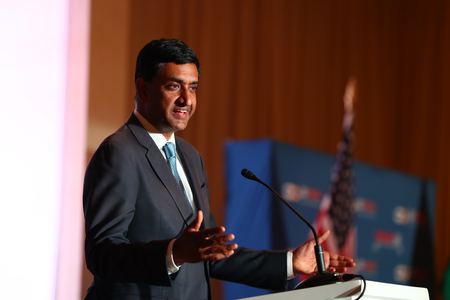
Washington, June 30 (IANS) Delivering his remarks at the US-India Strategic Partnership Forum (USISPF) Leadership Summit, Democratic Congressman Ro Khanna sharply criticised President Donald Trump’s foreign and immigration policies while arguing that the India-US partnership should ultimately be anchored in shared democratic values rather than transactional interests.
Khanna, who represents California’s Silicon Valley and is regarded as one of the Democratic Party’s leading voices on technology and foreign policy, devoted much of his address to attacking Trump’s approach to global alliances, tariffs and immigration before outlining his vision for America’s relationship with India.
He accused the Trump administration of weakening America’s global standing through unilateral actions and trade policies.
“We’re gonna have to rebuild our relationships around the world,” Khanna said, arguing that the next generation of American leaders would have to restore the country’s credibility abroad.
But amid the political criticism, Khanna devoted the latter part of his speech to what he described as the deeper purpose of the India-US relationship, saying it should extend beyond defence, trade and investment to reflect the shared democratic ideals of both countries.
“My hope as an Indian American… is that as we talk about the US-India relationship, we talk beyond what the defense relationship is, what the economic relationship is, what the investment relationship is.”
“Let’s talk about what the relationship needs to be in terms of our highest values, the values of seeing human freedom flourish here and around the world.”
“The value of seeing self-determination flourish here and around the world.”
“The values of seeking a world that is at peace, working to solve civilization’s problems.”
“It’s not about a blind alliance…It’s about finding an alliance that will further the values of civilization and humanity.”
Khanna framed his remarks around America’s historical role as a champion of democracy and decolonisation, contrasting President Franklin D. Roosevelt’s foreign policy with what he described as Trump’s more transactional approach.
“FDR actually believed in the self-determination of people.”
“When Winston Churchill said that the British Empire should not…”
“America is for decolonization.”
“America is for freedom.”
“America is for being a good neighbor.”
“America is for the principle of human rights and liberty, not just in the United States, but around the world.”
He said those ideals had inspired generations of immigrants, including his own family, to make America their home.
“That’s what inspired my parents to come to America.”
“That’s what inspired somebody here to come to the United States.”
Khanna also criticised the administration’s immigration policies, arguing they undermined America’s ability to attract the world’s best talent at a time of intense technological competition.
“He talks about leading in AI.”
“Thirty-eight per cent of the top AI researchers are Chinese origin.”
“Seventy-two per cent have foreign degrees.”
“This is a president who doesn’t understand that we need to be recruiting talent, not turning talent away.”
Looking ahead to the US elections, Khanna predicted a Democratic resurgence.
“The Democrats are gonna win decisively in 2026 and we’re gonna win in 2028.”
“We’re gonna have a reemergence of this country,” he said.
He argued that America had repeatedly demonstrated an ability to renew itself after periods of political and economic upheaval. “America has a remarkable capacity for self-correction.”
“Our destiny is to be the first cohesive, multiracial democracy.”
Describing himself as “an Indian American of Hindu faith,” Khanna said he drew inspiration from his grandfather, who participated in India’s independence movement, and from generations of Americans who fought to expand democracy and civil rights.
“My hope as an Indian American… is that we talk about the US-India relationship” in terms of advancing freedom and human dignity, he said.
Khanna has represented California’s 17th Congressional District since 2017 and is one of the most prominent Indian-American members of Congress.
His Silicon Valley constituency includes many of the world’s leading technology companies, and he has consistently advocated closer India-US cooperation in innovation, artificial intelligence and advanced technologies while remaining an outspoken critic of several Trump administration policies.
His remarks came as India and the United States continue to deepen cooperation across defence, trade, semiconductors, artificial intelligence and critical technologies.
While Khanna’s speech was overtly political, his central message was that the long-term strength of the bilateral partnership would ultimately depend on the two democracies remaining committed to the values of freedom, pluralism and self-determination that he argued had historically united them.
–IANS
lkj/rs