

Radio Brisvaani
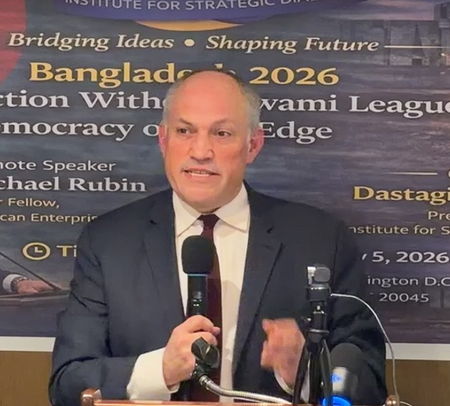
Washington, Feb 6 (IANS) Bangladesh’s upcoming national elections will not be free or fair, a senior American scholar said warning that the exclusion of major political parties has already stripped the process of democratic legitimacy.
“There’s absolutely not gonna be free and fair elections in Bangladesh,” Michael Rubin, a senior fellow at the American Enterprise Institute think-tank, told IANS when asked about the credibility of the vote.
Rubin said genuine elections require open competition. “The only way to have free and fair elections in Bangladesh is to have the mainstream political parties, which most Bangladeshis support, actually compete,” he said.
He said efforts to bar the Awami League reflected political fear rather than democratic principle. “The fact that Mohammad Yunis (chief advisor) and Jamaat-e-Islami want to ban the Awami League is simply determined by the recognition they have that in a free and fair election, the Awami League would win,” Rubin said.
Earlier, in a keynote address at a conference on Bangladeshi elections organized by the Institute for Strategic Dialogue, Rubin warned that Bangladesh could emerge as a defining foreign policy crisis for the United States.
“The crisis, which is now looming and which in many ways seems to be almost like a slow-motion train wreck, is what’s happening in Bangladesh,” Rubin said, arguing that Washington has failed to think proactively about developments under Nobel Laureate Muhammad Yunus, who has served as chief adviser since August 8, 2024.
Challenging the prevailing narratives about political unrest in Bangladesh in mid-2024, he said: “What we now know, of course, is that the protests, which we saw, were not organic.”
He compared elections held under such conditions to authoritarian systems. “If you have an election… when a party like the Awami League is banned, then in effect what you’re talking about is an election akin to what we’ve seen in the past in the Soviet Union or in the Islamic Republic of Iran,” Rubin said.
Rubin also alleged external interference. He said Pakistan continues to view Bangladesh as “East Pakistan” and claimed that Pakistani authorities have funded a student-led political party aligned with Jamaat-e-Islami. He said evidence of such funding was “rock solid,” though largely underreported.
He warned that diplomatic isolation worsens misjudgments. “It’s very hard for diplomats to actually get outside the embassy and see the reality of the societies which they’re supposed to be reporting upon,” Rubin said, arguing that reliance on narrow contact networks distorts US assessments.
–IANS
lkj/rs